Sunday Times: Comedy-on-Prescription: the patients using stand-up to combat depression
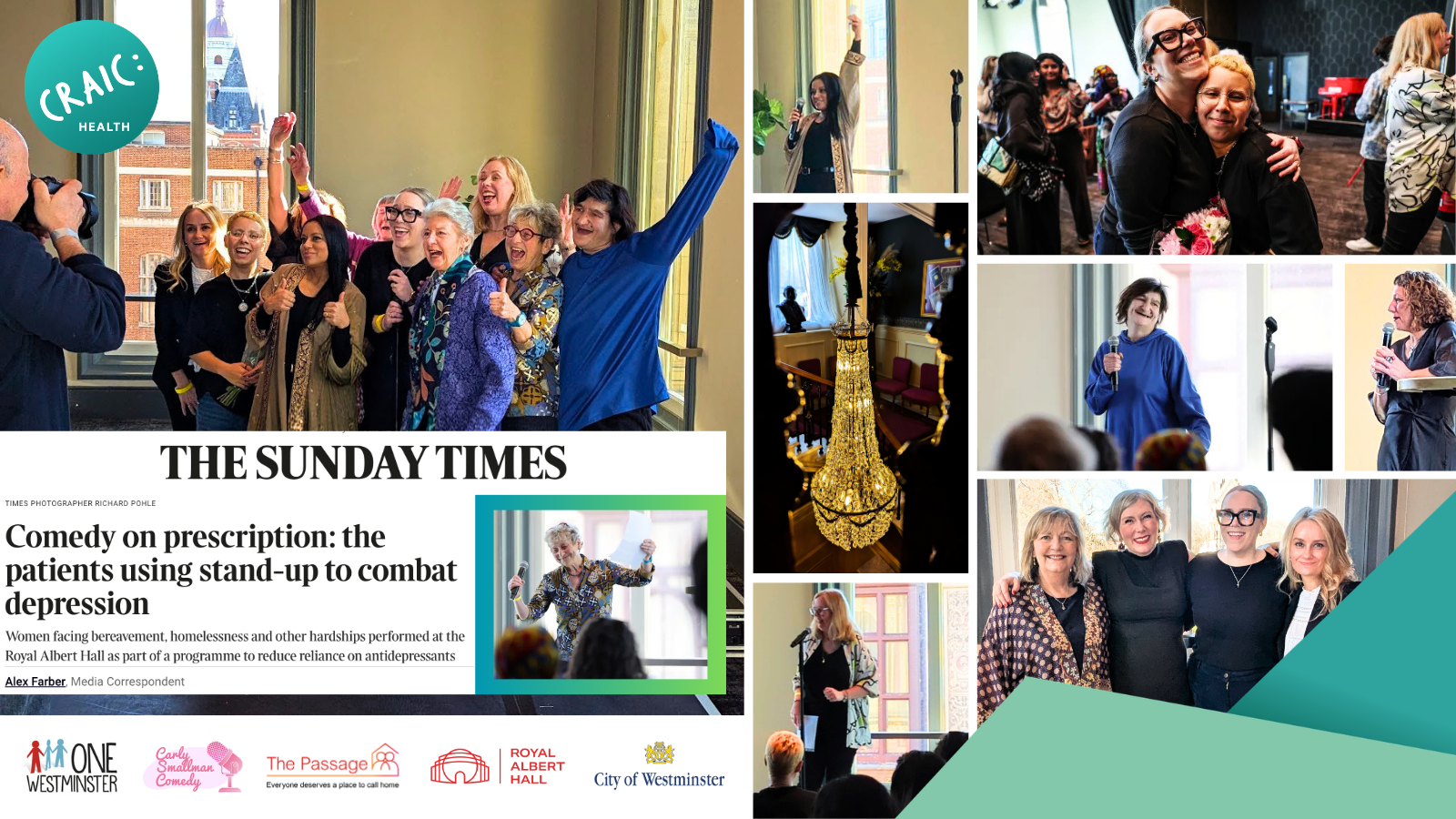
Sunday Times photos by Richard Pohle and other photos by Craic Health Founder, Lu Jackson
This article featured in the Sunday Times, written by Media Correspondent Alex Farber
Women facing bereavement, homelessness and other hardships performed at the Royal Albert Hall as part of a programme to reduce reliance on antidepressants
Depression costs the public purse tens of billions of pounds a year and nine million patients are on medication.
Now a trial has taken inspiration from the adage that laughter is the best medicine, by employing a professional comedian to teach patients how to perform stand-up routines.
This month, seven women delivered live performances in front of an audience of friends, family and supporters at the Royal Albert Hall. The aim of the “Comedy-on-Prescription” programme is to boost confidence and reduce reliance on antidepressants.
Claudia Merlich, 77, signed up to the course after struggling with the onset of her husband’s dementia and the death of her mother, all while weighing up the prospect of downsizing her home. “The course has given me a sense of fun and helped me relate to a diverse range of women who I wouldn’t usually meet,” she said.
Tracey, a 42-year-old homeless woman who previously found that antidepressants did not work for her, said that her key worker had recommended the course.
“It’s unbelievable how much it has helped my self-confidence,” she said. “I wouldn’t have even imagined being able to perform on a stage six weeks ago but I have got so much from it and the techniques that they have taught us which has helped me in my everyday life.”
Her key takeaways included trying to be more optimistic and positive. “Even when things are bad there is always a shining light,” she said. “From here I feel like I can go to the stars.”
The scheme was founded by Louisa Jackson, founder of Craic Health, because of her concerns that the non-medicinal remedies at GPs’ disposal did not go far enough.
NHS-endorsed “social prescribing” measures designed to reduce reliance on antidepressants include dog-walking, community gardening and museum trips, and Jackson is on a mission to get comedy added to the list.
The pilot scheme has been created to prove to NHS bosses that laughter can be a valuable healthcare tool. Previous studies have shown that laughter can provide significant mental health benefits and act as a natural way to combat stress, anxiety and depression.
Although some waiting to perform at the London landmark looked nervous, their pride after overcoming their fears and delivering their routines was palpable. The event featured six “comics” who had been struggling to cope with issues including homelessness, bereavement and dementia before the programme began six weeks ago.
“At the moment, people are being given antidepressants after an eight-minute GP appointment, so there is a big move towards intervention and prevention,” Jackson said. “You can be prescribed museum trips, gardening or going to the gym, but comedy is considered a joke. We want the NHS to integrate comedy into social prescribing so GPs can safely refer their patients to Comedy-on-Prescription providers.”
Jackson secured a grant from the community charity One Westminster and set up a series of “stand up and shine” workshops for women facing an array of issues. She partnered with Carly Smallman, a comedian, who ran sessions at the Passage, a homelessness charity. There the group were encouraged to share funny stories about their lives and were taught how to write jokes. They also took part in voluntary laughter exercises to boost their happiness and reduce inhibitions.
The trialists were asked to fill in a form to measure their wellbeing after each session to assess whether their mental health had improved.
Jackson is now trying to convince more bodies, to fund further pilots to build up a sufficient body of evidence to convince NHS bosses to add comedy to the basket of social prescriptions. She wants to extend the trials to include veterans suffering from PTSD, victims of severe trauma and disillusioned young men at risk from toxic influencers.
“Men don’t tend to access traditional services like counseling so comedy is a great way to help improve their confidence,” she said.
Smallman said that the results she had witnessed were entirely positive. “A lot of the group came in saying that they were lonely or wanted social connections,” she said. “The group’s confidence definitely improved. The aim was to help them to feel a bit better about themselves and now by performing at the Royal Albert Hall to make them feel like complete bad asses. I feel like a proud auntie.”
Simon Opher, a doctor and the Labour MP for Stroud, who has been supporting Craic Health, said: “With around 8.9 million people in England being prescribed antidepressants, non-medical interventions such as ‘comedy on prescription’ must be taken seriously as an alternative to the prescription pad.
“After more than 30 years as a GP, I’ve seen first-hand the power of social prescribing — from gardening allotments and art classes to walking football. Comedy is an innovative addition, creating space for people to connect, reflect on their experiences, and build confidence through laughter. Seeing the first cohort graduate in Westminster is a powerful proof of concept, and I hope to see more local authorities adopt similar approaches.”