Financial Times: Comedy-on-Prescription—the NHS trial turning patients into stand-ups
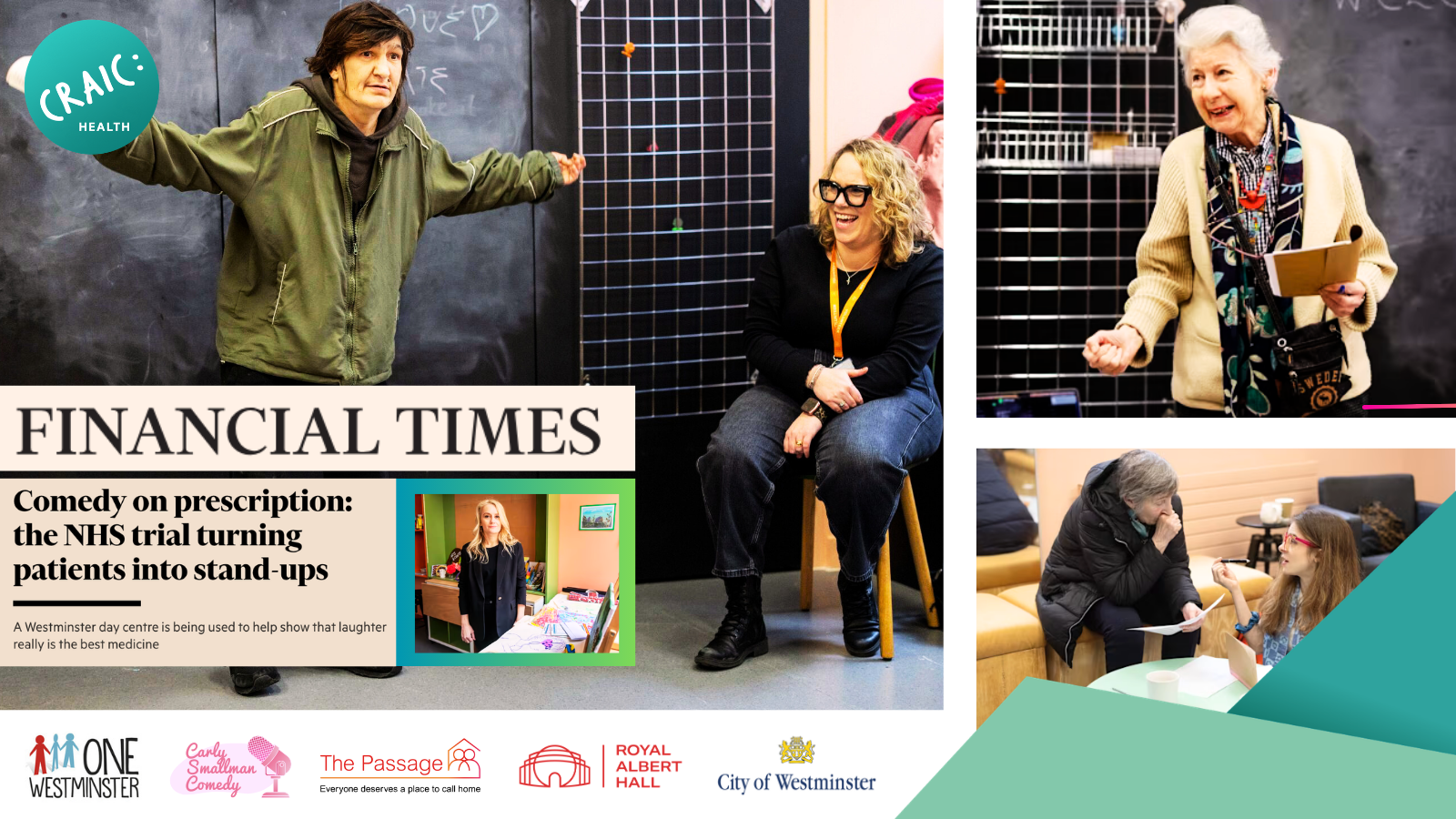
Financial Times photos by Anna Gordon
This article featured in the Financial Times, written by Public Policy Correspondent Laura Hughes
In a quiet room in central London, a circle of women clutch small notepads as they are helped to turn some of the hardest moments of their lives into stand-up comedy.
The group comes from very different walks of life, ranging from the homeless, working professionals, those recovering from addiction and others who are just lonely or out of work.
At The Passage, a day centre for homeless people in Westminster, Carly Smallman, an award-winning comedian, guides the women as they create comic material that they will have the option to perform in public at the Royal Albert Hall next month.
They are all taking part in a six-week “Comedy-on-Prescription” trial, which is designed to build the evidence base needed to show that prescribing stand-up lessons for patients with mild or moderate depression can be used as a complement or alternative to medication.
The goal is to enable comedy and laughter-based workshops to be recognised within the NHS as a “safe healthcare intervention” by the end of the year, said Louisa Jackson, the founder and CEO of Craic Health, the organisation behind the initiative, which is currently running pilot trials in Westminster.
GPs and nurses working inside the NHS already use social prescribing to help people with loneliness and mental health challenges by connecting them with local gardening or art groups in response to long waiting lists for talking therapies and concerns about overprescribing antidepressants.
The model forms a key part of the government’s 10-year NHS plan to reform the struggling service, which aims to shift more care into the community and reduce pressure on overstretched GPs and hospitals.
“They’ve been integrating arts, museums and gardens into prescription services for years,” noted Jackson.
“Comedy is the last major creative industry that hasn’t been integrated, but there is already a huge amount of global research on laughter. That gives us an opportunity to expedite integration into NHS policy — but we still have to prove it works,” she added.
“I’ve been a comedian for a long time, and I found that stand-up has really helped my mental health,” said Smallman. “Before I did comedy, I used to have panic attacks all the time. Since I started performing, they’ve really eased up. I thought to myself, I don’t think that’s a coincidence. So what I’m trying to do is pass that on.”
“The idea is that we build different stand-up skills each week so they have at least one to two minutes they could perform on stage if they want to,” she added.
Among the sketches performed is one of a woman who loves to complain and gives herself the nickname “Pablo Escalate”.
Tracey, 42, recounted how, as a homeless woman, she would innocently ask strangers for the time, only to encounter irritation because they thought she was asking for spare change. Her comic timing is impeccable, drawing laughter from the room, but beneath the humour lies a sobering reflection on how society treats the homeless.
“My key worker thought these workshops would be good for me,” she said. “It’s been brilliant and a good group of people as well.”
For Opal, one of the group attendees, these workshops offer something different from more traditional routes for tackling mental health issues. “Medication can help, but this is a natural way — laughter increases serotonin, those happy hormones. There are no side effects to laughing.”
She added that it was “empowering” to put herself out there and believes comedy can also open up difficult conversations as “an amazing tool to talk about things people don’t want to talk about.”
Dr Simon Opher, a former GP and Labour MP for Stroud, said the use of comedy workshops like these offered an “alternative route that can help to de-medicalise mild to moderate symptoms.”
“We know there is too much prescribing going on but often that’s because there just aren’t these alternatives to point people towards”, he said. “It’s never going to be for the most seriously unwell, but we know laughter really can make us all feel better.”
Participants fill in a survey adapted from the Warwick‑Edinburgh Mental Wellbeing Scale, which asks about optimism, relationships and coping with problems. Before and after each session, they write one word describing how they feel.
“A GP isn’t going to stop prescribing antidepressants and tell someone to go to their local workshop instead,” noted Jackson. “But for many people, connection is what they’re missing. There will always be cases where social prescribing, including comedy, isn’t appropriate. That’s why we do careful check-ins and train providers to spot trauma responses and safeguarding issues.”
Vivian, 82, said she was drawn to the event by a desire for connection after losing her husband and a number of close friends. “It’s true that in life tragedy and comedy can be so close,” she said.
Comedy, she added, has always been her release. “Billy Connolly nearly kills me laughing. I laugh so much my stomach really hurts. I feel like I might die laughing.” After a pause, she added: “To die from laughter? Well, what a lovely way to go.”