

Comedy-on-Prescription in Australia
Mental Health Support in Australia
*For urgent help, call 000 or go to your nearest Emergency Department
For non-emergency support, contact:
13YARN: 24/7 crisis support for Aboriginal & Torres Strait Islander people | 📞 13 92 76
1800RESPECT: Domestic, family & sexual violence support (24/7) | 📞 1800 737 732
Beyond Blue: Anxiety, depression, wellbeing support | 📞 1300 22 4636
Brother to Brother: 24/7 support for Aboriginal men | 📞 1800 435 799
headspace / eheadspace: Youth mental health support (12–25) | 📞 1800 650 890
healthdirect: 24/7 health advice | 📞 1800 022 222
Kids Helpline: Support for ages 5–25 | 📞 1800 55 1800
Lifeline: 24/7 crisis support | 📞 13 11 14 | 📱 Text 0477 13 11 14
MensLine Australia: 24/7 support for men | 📞 1300 78 99 78
Orange Sky: Free mobile laundry support (and in some locations, showers) | Find a van near you
Suicide Call Back Service: 24/7 counselling for suicidal thoughts / suicide bereavement | 📞 1300 659 467
National Organisations
ASPIRE — Australian Social Prescribing Institute of Research & Education
Australia’s emerging social prescribing institute focused on growing evidence, education, and national collaboration.
Australian Centre for Arts & Health (ACAH)
Australia’s peak arts-and-health body—research, sector resources, and connections across creative health practice.
RACGP — social prescribing adoption update
Royal Australian College of General Practitioners update on how GPs are adopting social prescribing and why it matters.
Find Support
healthdirect — Service Finder
National directory to find local services by suburb/postcode (GPs, community health, allied health, hospitals) with contact details.
Ask Izzy — national support services directory
Free directory of support services (housing, food, counselling, family violence, money help and more) searchable by location and need.
Medicare Mental Health — service search
Government-backed starting point to find mental health and wellbeing supports, services, and pathways in Australia.
Head to Health Clinics
Australian Government page explaining Head to Health Clinics and how to access free support (including phone and in-person options).
Local Primary Health Network (PHN) Entry Points
PHN Locator Map (national)
Interactive map to identify your local Primary Health Network (PHN) region and access contact details.
PHN Contacts (national list)
Official list of all PHNs with contact information—useful for partnership enquiries and regional pathway mapping.
Australian Capital Territory (ACT) — ACT PHN
ACT PHN information and the organisation responsible for PHN delivery in the territory.
New South Wales (NSW) — NSW PHNs
Links to PHNs across NSW (regional commissioning and coordination of primary/community health services).
Northern Territory (NT) — NT PHN
NT PHN information and the organisation responsible for PHN delivery in the territory.
Queensland (QLD) — QLD PHNs
Links to PHNs across Queensland for regional commissioning and referral pathway coordination.
South Australia (SA) — SA PHNs
Links to the PHNs across South Australia (metro and country regions).
Tasmania (TAS) — TAS PHN
Tasmania has one PHN region—this page covers who manages it and key regional info.
Victoria (VIC) — VIC PHNs
Links to PHNs across Victoria for regional commissioning and coordinated care pathways.
Western Australia (WA) — WA PHNs
Links to PHNs across WA (Perth North, Perth South, and Country WA).
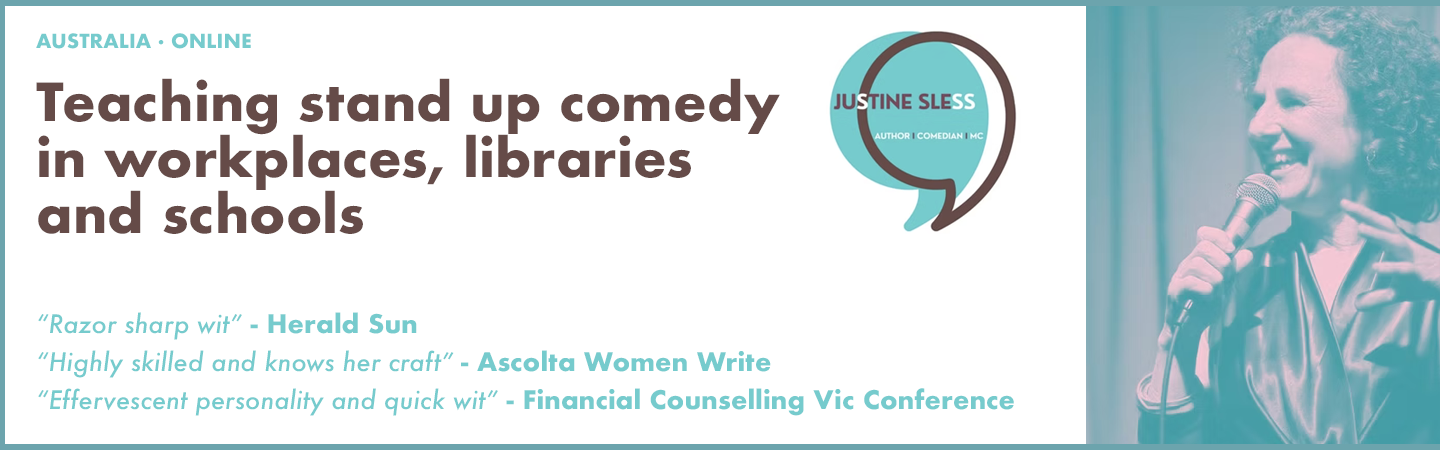
“I’ve been teaching comedy and creative writing within social prescribing frameworks for 20 years—across schools, workplaces and libraries, with adults and children. I specialise in working with people experiencing complex mental health needs, those living in rooming houses, and people at risk of homelessness. I have a background in community development, I’m a trained Lifeline Counsellor, with a Master’s by Research in Creative Writing. I’m the author of two books on comedy and loneliness, with a third—on gender, class and comedy—publishing in 2026.
The incredible work of Craic’s founder, Lu Jackson, is legendary — I now have the language, connection and affiliation with other practitioners who teach comedy in a social prescribing format.”
Justine Sless– Melbourne, Australia
Comedy & Creative Writing Workshops in Workplaces, Libraries and Schools • Author • Comedian
Justine delivers comedy and creative-writing workshops, supporting participants from children (5+) through to seniors. Her workshops have helped people across mental health and social isolation (loneliness, anxiety, low mood), neurodiversity and access needs, housing insecurity and financial hardship, recovery and sober-curious communities, and communities affected by trauma, assault or abuse—including parents and perinatal/postnatal participants (via her programme Parenting and Other Interrupted Conversations). Participant feedback describes her as “knowledgeable” and “supportive,” with a clear, simple teaching style that helps people take positive risks: “Justine gave clear and simple guidance and feedback,” and participants report being supported to step “out of my comfort zone,” which they “thoroughly enjoyed.”
Humour Studies in Australia
Australasian Humour Studies Network

Craic is proud to work with the Australasian Humour Studies Network (AHSN), which is dedicated to research into comedy and humour-related topics and to connecting humour scholars in different academic disciplines and locations across the world. As its name implies, its core membership is in Australia and New Zealand and offers a program of annual conferences and other resources, including links to the International Society for Humor Studies (ISHS), other regional humour research groupings, and the European-based International Summer-School in humour and laughter.
Its conference proposals are always peer-reviewed to ensure quality and to guarantee wide participation from different perspectives, including those of practitioners as well as academic specialists. After all, multi-disciplinary enquiry is the key to achieving significant insights into the complexity of humour. Membership of the AHSN mailing list is free of charge for receiving its occasional “Humour Studies Digest” with news and announcements of forthcoming events. Its annual conference and some other events require payment of a registration fee, as the AHSN is not supported by any grants. It does offer a number of fee-waivers as competitive scholarships for outstanding research students.
Since launching in 1997, ASHN now has over 350 scholars and practitioners in more than 25 different disciplines and professions. The AHSN is governed by a small Board of officers and appoints a larger Review Panel of established scholars to provide peer-review across its many disciplines and practice-areas.

Performance Comedy As An Agent of Change

“Comic performance is one of Australia’s most important cultural forms, providing a major platform for social commentary and aesthetic innovation.
Comic performance plays a unique role in shaping national character; in revealing and critiquing the tensions between affirmation of identity on the one hand – with its inevitable exclusions and sometimes oppressions – and liberation, heterogeneity and subversion on the other. Indigenous comedic performance, for example, has been a major point of cross-cultural contact and an important medium for Indigenous voice and resistance. Likewise convicts, working class people, women, and post-war migrants deployed a carnivalesque humour to subvert authority and express alternative or democratic Australian identities.
Whether on stage, screen, audio, TV or streaming, performance comedy has been at the forefront of freeing up what is permissible in art and the public sphere and helped legitimise ideas and agendas emerging from social change and identity movements spanning workers’ rights, anti-war, feminism, land rights, environmentalism, LGBTIQA+ and multicultural diversity.
Culturally, comedy has become embroiled in debates over what is racist, what is sexist, what is offensive, who we can laugh at what, when and why.”
Monash University Australia “Comedy Country: Australian Performance Comedy as an Agent of Change”
Australia’s National Feasibility Study
Australia’s National Feasibility Study on social prescribing recommends establishing a National Framework and a National Centre—and notes that funding mechanisms would need to be established to support scaled delivery, including:
1. Creating a new Medicare Benefits Schedule (MBS) item (or using existing items) to fund GP/non-clinical needs assessment and referral work
2. PHN-led co-commissioning/contracting of local social prescribing services (with other government and community partners)
3. A grants program to help general practices embed link workers (alongside establishing a National Centre)
This proposes pathways for government/Medicare-adjacent funding for the referral + link worker mode. Medicare is not currently paying CoP providers to deliver Comedy-on-Prescription. In the UK, the National Academy for Social Prescribing (NASP) has published 13 evidence publications (Commissioned by NHS England). The evidence review found that ‘social prescribing schemes can deliver between £2.14 and £8.56 for every £1 invested, by reducing pressure on the NHS. This includes reductions in GP appointments, hospital admissions; and A&E visits for people who have been referred to social prescribing’.
Craic is working in the UK and Australia to get comedy recognised within Creative Health, including to train and supervise the world’s first cohort of Comedy-on-Prescription providers on the ground locally. In the meantime, comedy professionals are going by the title Comedy-on-Prescription facilitators.