Independent Nurse Magazine: Laughter is the best medicine
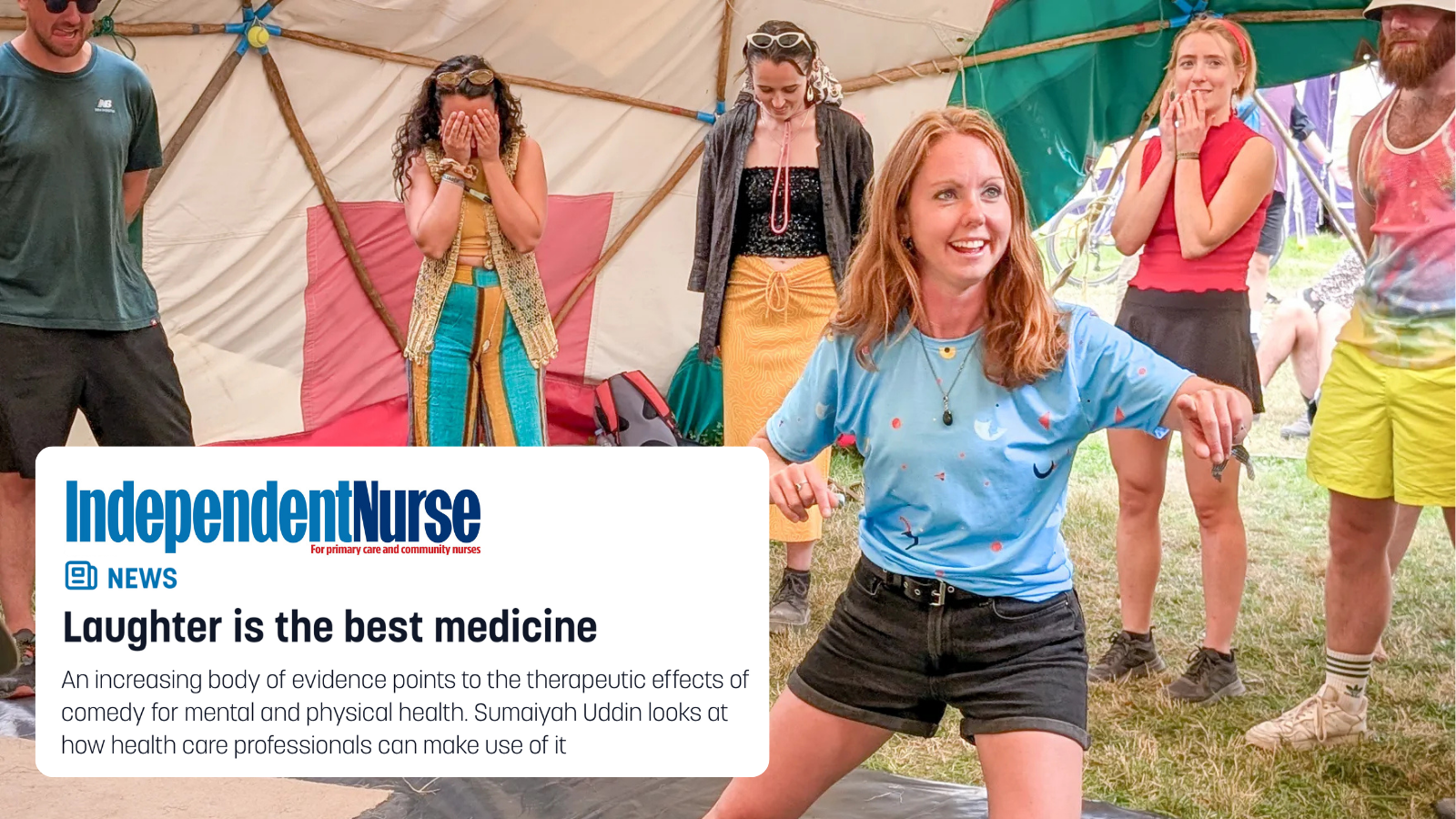
Comedy-on-Prescription Network: Viki Jackson of Playface with her community
This article originally appeared on the Independent Nurse Magazine website
Laughter is the best medicine
An increasing body of evidence points to the therapeutic effects of comedy for mental and physical health. Sumaiyah Uddin looks at how health care professionals can make use of it.
By Sumaiyah Uddin, 30 June 2026
Laughter has long been recognised as a coping mechanism or an insignificant, involuntary reaction, but it is now beginning to take on a more formal role within healthcare.
Across the UK, comedy-based wellbeing projects are being piloted through NHS-linked social prescribing schemes and community mental health services, reframing humour as a tool not just for distraction, but for physiological and psychological support.
The idea that laughter can heal goes back to the Old Testament. Proverbs 17:22 states: ‘A cheerful heart is good medicine, but a broken spirit dries up the bones.’ But in recent decades, researchers have begun to look at laughter not just as a psychological response, but as a measurable physiological process with tangible health effects.
For instance, a randomised clinical trial study from Brazil looked at the effects of laughter rehabilitation therapy on patients with stable coronary artery disease, by allowing a target group of patients to watch comedy shows, with a control group watching ‘neutral documentaries’. They found that the target group showed improved breathing as well as better endothelium-independent function and overall better recovery.
One advocate of this approach is Dr Simon Opher, Labour MP for Stroud and GP. In 2025, Dr Opher spoke in Parliament about the benefits of ‘creative health’ initiatives such as music and comedy, and how they could reduce waiting lists.
'From a social prescribing and GP perspective, I can see real potential for laughter and comedy-based interventions to support patients with mild to moderate depression, anxiety disorders, PTSD-related anxiety symptoms, post-natal depression, and people experiencing loneliness and social isolation,’ Dr Opher told Independent Nurse. ‘In particular, this could be helpful for groups who sometimes struggle to engage with traditional talking therapies, including some men, older people experiencing isolation, and veterans living with trauma-related anxiety.’
Of these initiatives, he cited the campaign ‘Comedy-on-prescription’ which explores and advocates for comedy as a tool for wellbeing.
In 2026, new Comedy-on-Prescription trials were launched in Westminster by the ‘creative healthcare’ hub Craic Health to actively test structured laughter-based workshops within NHS-linked initiatives, following early data which suggested high engagement and measurable improvements in wellbeing. Further studies have explored the biochemical mechanisms underpinning these effects. Early research demonstrated that laughter can reduce levels of stress hormones such as cortisol and epinephrine, while simultaneously enhancing immune activity, including increased natural killer cell function. More recently, a meta-analysis in 2023 reinforced these findings concluding that spontaneous laughter interventions are associated with measurable reductions in cortisol levels across multiple studies, positioning it as a potential modulator of stress physiology.
‘Laughter has been viewed as a form of medicine,’ Lu Jackson, founder of Craic Health said. ‘It has positive psychological, physiological, and social effects. Evidence suggests laughter can help reduce stress responses, support cardiovascular function and improve mood with the release of endorphins, serotonin, and good neuropeptides. In groups, it accelerates connection and belonging – protective factors for wellbeing, particularly when loneliness and isolation are part of the problem.’
This growing evidence base is particularly relevant in the context of modern healthcare systems, where rising demand for mental health support has placed increasing pressure on primary care services. In the UK, social prescribing has emerged as a key strategy in addressing this challenge, offering patients access to non–clinical interventions such as community groups, creative activities and physical exercise. Within this framework, humour-based initiatives are finding a place.
Research has also explored its impact on vascular function. A study published in the American Journal of Cardiology found that ‘mirthful laughter’ led to improved endothelial function, with increased arterial compliance observed immediately, and effects lasting up to 24 hours. Such findings suggest that laughter may play a role in promoting blood flow and reducing cardiovascular strain.
Comedy-on-Prescription
A trial from Turkey found that structured laughter interventions significantly reduced loneliness while improving psychological resilience and overall quality of life in older adults. While small in scale, such studies reflect a growing effort to examine laughter not only as a momentary emotional response, but as a structured, repeatable intervention with measurable outcomes.
Schemes such as Comedy-on-Prescription, developed by Craic Health, aim to formalise this process by integrating comedy into NHS-aligned pathways, and positioning it as a credible component of preventative care.
‘Comedy is culturally mainstream but systemically invisible,’ Ms Jackson said. ‘Mental ill health is the defining health challenge of our time, and healthcare systems can’t afford to ignore interventions that are low-cost, preventative, and that people genuinely engage with.’
The programme is designed to intervene early by supporting mood, confidence and social connection before individuals reach crisis point. Through partnerships with NHS bodies, academic institutions and creative health organisations, Craic Health is working to build an evidence base that will allow comedy to be scaled responsibly within social prescribing frameworks. Early pilot data has indicated a 44% uplift in mood among participants, with further trials underway to assess longer-term outcomes.
Beyond the data, however, the impact of such initiatives is perhaps best understood through individual experience.
‘I attended ‘JOYtalk’, a stand-up and “funny inspirational” event, led by ‘CoPper’ (Comedy-on-Prescription providers) Joy Carter,’ Ms Jackson said. ‘In the audience I recognised an elderly lady who attended two sessions from our first pilot workshops in 2025. She explained that most of her friends had died, moved into care, or relocated. Our comedy events helped her have a laugh and feel less alone.’
This emphasis on connection aligns closely with the principles underpinning social prescribing. As health systems increasingly recognise the role of social determinants in shaping health outcomes, interventions that foster community engagement are gaining prominence. Laughter, when experienced collectively, appears to address these factors directly. It creates shared moments of recognition and release, reinforcing social bonds and reducing feelings of alienation. For individuals who may feel disconnected from traditional support structures, this can be particularly valuable.
The potential applications of laughter-based interventions are not limited to mental health. In clinical settings, particularly within paediatric and oncology care, humour has been used as a complementary tool to support patients undergoing intensive treatment. It’s been suggested that humour interventions may positively influence immune function and overall wellbeing in patients with chronic illness, supporting their use as an adjunct to conventional care.
‘I’ve seen that when people come together regularly for something enjoyable like comedy, it can reduce loneliness, improve mood, and help people feel more connected to their community,’ Dr Opher said. ‘But beyond the physiological effects, laughter also helps people relax, sleep better, and feel more connected to others, all of which are important for recovery from both mental and physical health problems.’
Evidence is also emerging that laughter may affect pain perception. By stimulating endorphin release and diverting attention away from discomfort, humour can contribute to increased pain thresholds. This aligns with broader understandings of how psychological factors can modulate physical experience, particularly in conditions involving chronic pain.
In this context, laughter operates as a form of adjunct therapy, enhancing the effect of conventional treatment, rather than replacing it. Its low cost and minimal risks make it an attractive option, when compared to pharmacological interventions.
Conclusion
Integrating such approaches into healthcare systems presents its own challenges. While the appeal of humour-based interventions is clear, their effectiveness can be difficult to quantify. Outcomes such as improved mood or increased social connection are inherently subjective, requiring robust evaluation frameworks to ensure consistency and credibility.
Organisations like Craic Health are attempting to address this by developing tools to track outcomes and align interventions with established NHS metrics. By combining creative practice with clinical rigour, they aim to bridge the gap between informal wellbeing and formal healthcare.
Yet the broader direction of travel appears clear. As the NHS continues to grapple with rising demand for mental health services, alongside increasing recognition of the importance of preventative care, interventions that are both effective and accessible are likely to play an increasingly important role. Social prescribing, in particular, offers a cost-effective framework through which such approaches can be integrated, connecting patients with community-based resources that address the wider determinants of health.
The notion that laughter might be ‘the best medicine’ has long been treated as a cliché, yet accumulating evidence points laughter and comedy based-therapies towards a future as an emerging model of care, that can take place in shared spaces shaped by community.